Share:
Cream Charger Wholesale Pricing in 2026: Cost Per Case, Volume Tiers and Retailer Margins
Most buyers open a cream charger wholesale conversation with the wrong question. They ask “what is your price per charger?” — and then compare that number against another supplier’s number, as if the two are measuring the same thing. They almost never are.
This guide breaks down what actually sits inside a wholesale N₂O price, how volume tiers are normally structured, and the one calculation that lets you compare any two quotes honestly. If you run a retail shop, a catering operation, or you are reselling into the hospitality trade, this is the maths that decides whether your margin survives contact with reality.
What is actually inside a wholesale cream charger price
A quoted case price is the sum of several independent costs, and suppliers weight them very differently. Understanding the components tells you where a cheap quote is cutting corners.
The steel. A charger shell is a cold-drawn steel canister built to hold gas under pressure. Wall thickness and finish quality vary between factories, and this is the single easiest place to shave cost. Thin shells fail more often, and a failed charger in a professional kitchen is not a refund problem, it is a safety problem.
The gas fill. Food-grade nitrous oxide is designated E942 in the EU. The purity standard for culinary use is meaningfully higher than for industrial nitrous, and the certification and testing behind it costs money. If a quote is dramatically below market, the first question to ask is what grade of gas is in the canister and whether the supplier can produce documentation for it.
Filling, sealing and quality control. Batch testing, leak testing and weight verification all sit here. This is invisible in the product and very visible in your return rate.
Freight and duty. Pressurised gas is classed as dangerous goods for transport. Palletised freight, correct documentation and compliant handling are a real line item, and they scale badly on small orders. This is the main reason a twenty-box order and a full pallet have such different per-unit economics.
Packaging and breakage allowance. Retail-ready boxes, shrink wrap and the supplier’s own allowance for damaged stock.
How volume tiers are normally structured
Nearly every serious wholesale supplier works to three broad tiers. Knowing which one you are being quoted stops you comparing a starter price against someone else’s pallet price and concluding you are being overcharged.
Tier one — starter or trial volume. This is the entry point, usually a modest multiple of the minimum order quantity. At MonsterWhip the minimum order is 20 boxes. The purpose of this tier is to let you test the product, the packaging and the delivery process before you commit real working capital. Per-unit cost is the highest it will ever be, and that is the correct trade-off for a first order.
Tier two — standing wholesale. Regular, repeating orders at a predictable cadence. The supplier can plan production and consolidate freight, and the per-unit price drops accordingly. Most retail shops and catering businesses live here permanently.
Tier three — pallet and distributor volume. Full pallets, container-adjacent quantities, or a formal distributor agreement covering a territory. Freight cost per unit collapses at this level, which is where the largest share of the discount actually comes from. If you are reselling rather than consuming, this is the tier you should be working toward. We cover the requirements in our guide to wholesale supply and distributor terms.
The only comparison that works: cost per kilogram of gas
Here is the calculation almost nobody runs, and it is the one that matters.
Cream chargers and tanks are sold in wildly different formats — 8g chargers, 640g cylinders, 2kg and 3kg tanks. Comparing “price per charger” against “price per tank” is meaningless. Convert everything to cost per kilogram of nitrous oxide and the picture becomes obvious immediately.
The arithmetic is simple. A standard box of 24 chargers at 8g each holds 192 grams of gas. A case of 600 chargers holds 4,800 grams, or 4.8kg. So:
Cost per kg = (case price) ÷ (number of chargers × 8 ÷ 1000)
Run the same conversion on a 640g cylinder, a 2kg tank and a 3kg tank. Now every format is expressed in the same unit and you can see, in one column, which one is genuinely cheapest for your volume.
What buyers typically discover when they do this for the first time: the larger formats deliver substantially more gas per euro, but only if your throughput is high enough to use them before they tie up cash or shelf space. A 3kg tank sitting unsold for four months is more expensive than a slightly pricier case of chargers that turns over weekly. Cost per kilogram tells you the ceiling; your stock turn tells you whether you can reach it.
A worked margin example
Suppose you are a retailer. Take your landed case cost — the quoted price plus freight plus any duty, not the headline price. Divide by the number of retail units in the case to get your true unit cost. Subtract that from your shelf price to get gross margin per unit.
Then apply the two corrections almost everyone forgets:
Breakage and returns. If two percent of your stock is unsaleable, your effective unit cost is roughly two percent higher. Build it in.
Capital tied up in stock turn. A case that sells through in one week at a ten percent margin generates far more annual return than a case that sells through in three months at a twenty percent margin. Margin percentage without stock turn is a vanity number. Multiply margin by turns per year to get the figure that actually pays your rent.
This is why the cheapest quote frequently loses. A supplier who is reliably in stock, ships on schedule and does not force you to over-order to hit a price break will usually out-earn a marginally cheaper supplier who does none of those things.
The hidden costs that quietly destroy margin
Freight treated as an afterthought. Always ask for a landed price to your address. A quote that excludes dangerous-goods freight is not a quote.
Minimum order quantities that exceed your turn. Buying 500 boxes to hit a price break is a loss if you sell 40 a month. Buy to your actual velocity.
Slow-moving format mix. Order the ratio of 8g chargers to tanks that matches what your customers actually buy, not the ratio that produces the prettiest average unit cost.
Compliance and documentation. Under the EU chemicals framework, nitrous oxide supply is tightening, with significant changes due by 1 February 2027. A supplier who cannot produce food-grade documentation today is a supplier who may not be able to supply you at all in eighteen months. Continuity of supply is a cost, even when it does not appear on an invoice.
What to ask before you place a first order
Five questions that separate a real wholesale supplier from a reseller with a website:
What grade is the gas, and can you send the documentation? What is the landed price including dangerous-goods freight to my address? What is the minimum order, and what are the actual volume break points? What is your lead time, and what is your current stock position? What happens if a case arrives damaged?
If you get clear answers to all five, you are dealing with a supplier who has thought about your business. If you get vague answers, the price is irrelevant.
Where MonsterWhip sits
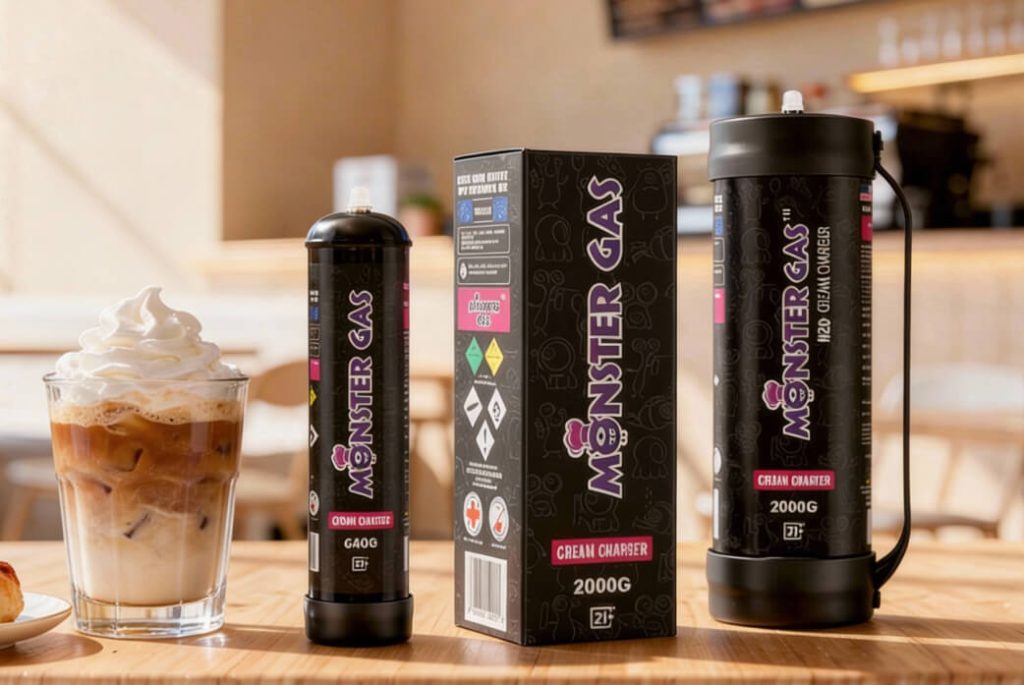
We supply food-grade E942 nitrous oxide for culinary use to trade buyers across North America and Europe and the United States, in 8g chargers, 640g cylinders, 2kg and 3kg tanks, and full pallet quantities. Minimum order is 20 boxes. Our products are supplied strictly for professional culinary applications.
We do not publish a fixed price list, for one honest reason: steel cost, gas cost and freight all move, and a published price is out of date the week after it goes up. Quoting live means the number you get is the number that is actually true.
If you want current pricing for your volume and format mix, message us on WhatsApp and tell us what you are buying today and how often. You will get a landed quote back, not a brochure.
Message MonsterWhip on WhatsApp for a live wholesale quote →
Further reading: wholesale cream chargers in Europe and our comparison of N₂O cream charger brands.
Recent posts
- Top 10 Best N2O Suppliers in the World (2026): Cream Charger Brands Ranked
- How to Become an N₂O Cream Charger Distributor in Europe: Requirements, MOQ and Margins
- Cream Charger Wholesale Pricing in 2026: Cost Per Case, Volume Tiers and Retailer Margins
- Mochi Squishies vs Stress Keyboards: What Actually Sells Through at Christmas
- The October Cutoff: Ordering Christmas Impulse Toys in Time for Black Friday