Share:
Private Label Cream Chargers: How to Start Your Own N2O Brand (2026 Guide)
If you sell cream chargers to restaurants, bars, smoke shops, or consumers and you’re still moving someone else’s box, you’re leaving margin on the table. Private label cream chargers — also called white label or OEM N2O chargers — let you sell food-grade nitrous oxide under your own brand name, your own packaging, and your own price point. This guide covers exactly what private label means in this industry, what it costs, what to check before you commit, and how to launch without the costly mistakes most first-time buyers make.
What “Private Label” Actually Means for Cream Chargers
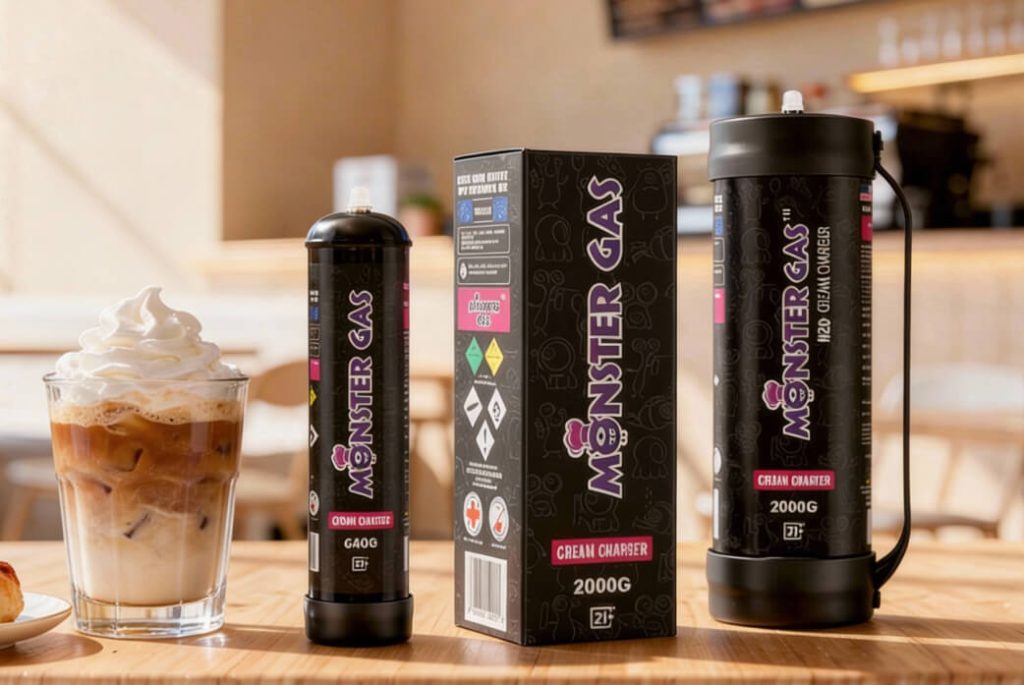
Private label (sometimes called white label or OEM — original equipment manufacturer) means a manufacturer produces the physical product to spec, and you apply your own branding before it reaches the end customer. For cream chargers, that typically covers:
- Cylinder color and finish — anodized colors, matte or gloss steel, custom-printed bodies
- Logo and label printing — your brand name, logo, and required regulatory text printed directly on the charger or on the box
- Packaging — custom boxes, retail-ready blister packs, or bulk case packaging with your branding
- Flavor and format — some manufacturers also let you choose from flavored N2O lines or specify 8g, 16g, or larger tank formats under your label
The gas itself, the pressure testing, and the food-grade certification come from the manufacturer — you’re not building a chemical plant, you’re building a brand on top of an already-certified supply chain.
Why Distributors and Retailers Are Moving to Private Label
Reselling a well-known brand means competing on price against every other reseller of that same brand — including the manufacturer’s own direct-to-business channel. Private label breaks that race to the bottom in a few concrete ways:
- Margin control. When the product carries your name, customers can’t price-compare it against ten other listings of the identical branded item.
- Customer retention. A private label product ties the customer to you specifically, not to a brand they could buy from a competitor.
- Brand equity. Every case you sell builds recognition for your business rather than someone else’s.
- Category expansion. Smoke shops, vape distributors, and hospitality suppliers increasingly want a “house brand” cream charger to sit alongside their other private label lines.
What You Can Customize (and What You Usually Can’t)
Realistic OEM programs typically allow customization of the label, box, and cylinder color/print at low-to-mid order volumes. Fully custom cylinder tooling (a unique shape or valve mechanism) usually requires much higher volume commitments and longer lead times, since it involves new manufacturing tooling rather than just branding an existing line. For most new private label buyers, the sweet spot is: standard 8g or 580g/640g cylinder format, your label and box design, manufacturer’s existing food-grade N2O fill.
Minimum Order Quantities and Realistic Budgets
MOQs for private label cream chargers vary by format and by how much customization you want:
- Label-only customization (your design printed on an existing cylinder/box) generally carries the lowest MOQ and can often be layered onto a standard wholesale pallet order.
- Custom cylinder color or full box redesign usually requires a full production run, which pushes MOQs higher and adds several weeks to lead time versus a stock order.
- Flavored or novel formats under private label typically sit at the top end of both MOQ and lead time.
Before committing, ask your supplier for the exact unit MOQ, the cost difference versus their stock product, and the lead time in writing — not a verbal estimate. If you’re not yet ready for a full private label run, you can still test the market by ordering a standard wholesale batch under the manufacturer’s branding first.
Food-Grade Certification: What OEM Buyers Must Verify
Putting your name on a product means the compliance liability sits with you too. Before signing off on any private label run, confirm in writing:
- The N2O is certified food-grade (E942) at 99.5%+ purity, ideally 99.7%+
- The manufacturer can supply a current Certificate of Analysis (CoA) per batch
- Cylinders carry valid pressure and safety certification (CE, TUV, or the equivalent for your market)
- Your printed label includes any legally required warnings, age restrictions, and food-additive labeling for the countries you’ll sell into
Skipping this step is the single most common private label mistake — a beautifully branded box means nothing if the product behind it isn’t verifiably food-grade and compliant.
Private Label vs. Reselling: Which Model Fits Your Business
Private label isn’t the right first step for everyone. As a rough guide: if you’re already moving consistent wholesale volume and want to protect margin and build a defensible brand, private label makes sense. If you’re still validating demand or your volume is modest, reselling under an established, trusted brand — while you build your customer base — is the lower-risk starting point. Many of our distribution partners run both: an established brand for price-sensitive volume, and a private label line for higher-margin, brand-loyal customers. Our guide on starting a cream charger distribution business covers this decision in more depth.
Step-by-Step: How to Launch Your Own Cream Charger Brand
- Validate demand first. Sell a standard wholesale batch under an existing brand to confirm your customer base and volume.
- Define your positioning. Budget/value, premium/boutique, flavored/novelty — your label design and price point should follow this, not the other way around.
- Request MOQ, pricing, and lead-time quotes from your supplier for label-only vs. full custom options.
- Get the compliance paperwork in writing (CoA, safety certification, required label text) before finalizing artwork.
- Approve a physical sample before committing to a full production run — never approve from a digital mockup alone.
- Plan your logistics for the larger case/pallet quantities private label runs typically involve.
Common Mistakes First-Time Private Label Buyers Make
- Committing to a full custom cylinder run before validating demand with a standard product
- Not requesting a Certificate of Analysis, then discovering purity issues after the brand is already printed
- Underestimating lead time and running out of stock during the transition from reseller to private label
- Skipping a physical sample approval and receiving a full run that doesn’t match expectations
How MonsterWhip Supports Private Label Partners
MonsterWhip supplies certified 99.7% food-grade N2O (E942), manufactured in Europe, to wholesale and OEM partners across the US and Europe. We work with distributors at every stage — from a first standard wholesale order to a fully branded private label line — and provide CoA documentation and safety certification with every batch. If you’re exploring a private label line, request a wholesale quote and mention private label/OEM so we can walk you through current MOQs and lead times, or reach out directly via WhatsApp for a faster conversation.
FAQ
What’s the minimum order for private label cream chargers?
It depends on the level of customization — label-only branding can often be layered onto a standard wholesale order, while custom cylinder colors or packaging require a full production run at a higher volume. Always get an exact number in writing from your supplier.
Is private label more expensive than reselling a branded product?
Per-unit cost is often similar or only slightly higher once you’re at a full production run — the real cost difference is the volume commitment and lead time, not the branding itself.
Do I need my own safety certifications if I private label?
You need to verify your manufacturer’s certifications (CE, TUV, food-grade CoA) transfer to your branded product and that your label includes any legally required text for your market — this is usually the manufacturer’s documentation, not a separate certification you obtain yourself.
Can I start with a small private label test run?
Some suppliers offer lower-MOQ label-only programs as a lower-risk entry point before committing to a full custom production run — ask specifically about this option.
Recent posts
- How to Spot Fake or Low-Quality Cream Chargers: A Wholesale Buyer’s Checklist
- 640g vs 2kg Cream Chargers: Which Size Is Right for You?
- Cream Chargers Chicago: Wholesale N2O for Restaurants, Bars & Catering
- Cream Chargers Miami: Wholesale N2O for Restaurants, Bars & Catering
- Cream Chargers Houston: Wholesale N2O for Restaurants, Bars & Catering