Share:
E942 Food Grade N2O: What It Means & Why It Matters for Your Business
E942 is the European Union food additive number for nitrous oxide (N₂O). If you see it stamped on a cream charger, a whipping siphon cartridge or a bulk N₂O cylinder, it means the gas inside has been approved for direct contact with food. It is chemically the same molecule as industrial nitrous oxide, but it is held to a different purity specification and carries a different documentation trail — and for a commercial kitchen, that paperwork is the difference between passing and failing a food safety audit.
E942 at a glance
| Additive number | E942 in the EU and UK; INS 942 internationally |
| Substance | Nitrous oxide, N₂O (dinitrogen monoxide) |
| Functional class | Propellant and packaging gas |
| Authorised under | Regulation (EC) No 1333/2008 on food additives |
| Safety assessed by | EFSA, the European Food Safety Authority |
| Permitted level | Quantum satis — no numerical limit is set, as none is needed for safety |
| Typical purity | ≥99.5% N₂O, with premium food-grade suppliers specifying ≥99.7% |
| Transport code | UN1070, the dangerous-goods number for the same gas in transit |
| Typical uses | Whipped cream, foams and espumas, aerated desserts, nitro coffee, packaging gas |
What Is E942 and Why Does It Appear on Cream Charger Labels?
If you’ve ever purchased food-grade cream chargers for your restaurant, café, or catering business, you’ve almost certainly seen “E942” printed on the canister or packaging. This alphanumeric code is the European Union food additive designation for nitrous oxide (N₂O) — the gas that powers every whipped cream dispenser in professional kitchens worldwide.
Understanding what E942 means, why it matters for your business, and how to verify that your supplier is delivering genuine food-grade product isn’t just regulatory box-ticking. It’s the difference between safe, consistent kitchen output and a serious compliance or safety risk. This guide covers everything you need to know.
The EU Food Additive System: How E Numbers Work
The European Union maintains a standardised list of approved food additives, each assigned a unique “E number.” These numbers are regulated under EU Regulation (EC) No 1333/2008 on food additives. Every substance on this list has passed rigorous safety assessments conducted by the European Food Safety Authority (EFSA) and is approved for specific food applications at defined purity levels.
E942 — nitrous oxide — sits in the category of packaging gases and propellants, authorised for use as a propellant in whipping cream applications. When you see E942 on a cream charger, it confirms the gas inside meets EU food-grade standards: a minimum purity of 99.5% N₂O, with tightly controlled limits on moisture, oxygen, and trace contaminants that could affect flavour, shelf life, or safety.
Food-Grade vs. Industrial-Grade N₂O: Why the Distinction Matters
Not all nitrous oxide is created equal. Industrial-grade N₂O — used in welding, automotive applications, and anaesthesia — is produced and stored under conditions that make it unsuitable for food contact. It may contain:
- Higher levels of residual sulphur compounds and lubricants from manufacturing equipment
- Moisture that causes premature degradation of whipping cream
- Contaminants that introduce off-flavours into espuma, whipped cream, and foam preparations
- Trace heavy metals from non-food-grade cylinder materials
Food-grade E942 is produced in dedicated facilities, tested batch-by-batch against food safety specifications, and stored in cylinders manufactured from food-compatible materials. The result is consistent, neutral-tasting N₂O that delivers reliable results every time — whether you’re charging a 0.5L pastry siphon or a 2kg commercial tank.
Food-Grade vs. Medical-Grade vs. Industrial-Grade N₂O
Most buyers assume nitrous oxide comes in two grades. It comes in three, and the middle one causes the most expensive mistakes.
| Grade | Designation | Minimum purity | Governed by | Legal for food use? |
|---|---|---|---|---|
| Food-grade | E942 / INS 942 | ≥99.5%, premium ≥99.7% | Regulation (EC) No 1333/2008 | Yes — this is the only grade approved for food contact |
| Medical-grade | Nitrogenii oxidum | ≥98.0% | European Pharmacopoeia; supply restricted to licensed medical use | No — it is not authorised as a food additive, and diverting it to catering use is a regulatory offence |
| Industrial-grade | No food designation; shipped under UN1070 | No food specification | Nothing relevant to food safety | No — may carry oil residue, moisture and nitrogen oxides from the filling line |
Medical-grade is the trap. It sounds like the premium option, and chefs sometimes assume that anything clean enough for a hospital must be clean enough for a dessert. It is not a question of cleanliness. Medical nitrous oxide is manufactured, labelled and distributed as a pharmaceutical, under a completely separate legal framework. It carries no E number, it cannot legally be sold for culinary use, and using it in a commercial kitchen will fail an inspection even if the gas itself is pure.
Industrial-grade is the genuinely dangerous one. The same molecule, produced for pressure testing, motorsport and manufacturing, with no requirement to control for the contaminants that matter when a gas is going to dissolve into cream and be eaten. Oil carry-over from compressors and higher nitrogen oxide levels are the two usual problems, and neither is something you can detect by taste or smell.
How to Verify Your Cream Chargers Are Genuinely E942 Certified
Any reputable cream charger supplier should be able to provide the following documentation on request:
- Certificate of Analysis (CoA) — A batch-specific document confirming N₂O purity, moisture content, and absence of regulated contaminants. The CoA should be issued by an accredited third-party laboratory, not just the manufacturer’s internal QA department.
- Lot traceability — Every shipment should carry a lot or batch number that can be cross-referenced against the CoA. This is essential for HACCP compliance and food safety audits.
- EU food additive designation — The packaging should clearly state “E942” or “Nitrous Oxide E942” rather than simply “N₂O” or “food grade.” The E number is the regulated designation.
- Cylinder certification — Cylinders should carry ADR (European Agreement for the Transport of Dangerous Goods) markings and evidence of regular pressure testing (hydrostatic testing certificate).
At MonsterWhip, every order ships with full lot traceability and a Certificate of Analysis available on request. Our product is sourced exclusively from EU-certified production facilities and meets E942 purity specifications on every batch.
One document is routinely missed: food contact material compliance under Regulation (EC) No 1935/2004. The gas can be perfectly pure and still reach the plate through a valve, hose or dispenser component that was never approved for food contact. Ask for the declaration of compliance covering the hardware, not only the Certificate of Analysis covering the gas.
E942 in Practice: What It Means for Your Kitchen
For professional kitchen operators, E942 certification carries practical implications beyond compliance:
Consistency: Food-grade N₂O delivers the same whipping performance batch after batch. Industrial-grade gas can vary in moisture content, which affects cream texture — you may get stiff peaks one week and loose, unstable foam the next.
Flavour neutrality: E942-certified N₂O is odourless and flavour-neutral, ensuring it doesn’t interfere with delicate preparations. Espumas, infused creams, and flavoured foams depend on the gas being a clean carrier rather than a contaminant.
Legal compliance: Using non-food-grade gas in food production is a violation of EU food law. Kitchen operators found using industrial N₂O risk enforcement action from environmental health officers, loss of food hygiene certifications, and, in serious cases, criminal liability.
Insurance validity: Many commercial kitchen insurance policies require HACCP-compliant ingredient sourcing. Using uncertified gas could invalidate a claim if an incident occurs.
E942 and European N₂O Regulations in 2026
Several EU member states have introduced additional national regulations governing the sale of nitrous oxide, particularly targeting recreational misuse. These include the Netherlands’ nationwide N₂O ban (effective January 2023), France’s restrictions under the Loi visant à protéger les mineurs, and the UK’s reclassification of N₂O as a Class C controlled substance. However, in every jurisdiction that has introduced such legislation, wholesale B2B supply of food-grade E942 to licensed food-service businesses remains legal under professional use exemptions. MonsterWhip supplies exclusively to verified food-service accounts with appropriate documentation.
E942, INS 942 and UN1070: Three Codes, One Gas
A single cylinder of food-grade nitrous oxide can carry three different numbers, and they are routinely confused with one another. They answer three entirely different questions.
| Code | Issued by | What it actually tells you |
|---|---|---|
| E942 | European Commission | That this gas is an authorised food additive in the EU and UK. This is the quality and legality mark. |
| INS 942 | Codex Alimentarius Commission (FAO/WHO) | The same additive under the International Numbering System, used outside Europe. Identical substance, international label. |
| UN1070 | United Nations, via ADR transport rules | How the cylinder must be packed, labelled and transported. It says nothing whatsoever about food safety. |
This matters commercially. Suppliers sometimes advertise "UN1070 certified" nitrous oxide as though it were a quality credential. It is not. Every cylinder of nitrous oxide moving by road carries UN1070, including the industrial grade you must not put near food. If a listing leads with UN1070 and never mentions E942, that is a signal worth paying attention to.
The international picture is straightforward once the naming is clear. In Brazil, Mexico, Chile and most of Latin America the additive appears as INS 942 on technical documentation. In the United States there is no E number at all — nitrous oxide is regulated by the FDA and listed as generally recognised as safe (GRAS) for use as a propellant and aerating agent in dairy products under 21 CFR 184.1545. Different code, same approved substance, same purity logic. A supplier who can produce E942 documentation can almost always produce the equivalent for your market.
Ordering E942-Certified Cream Chargers from MonsterWhip
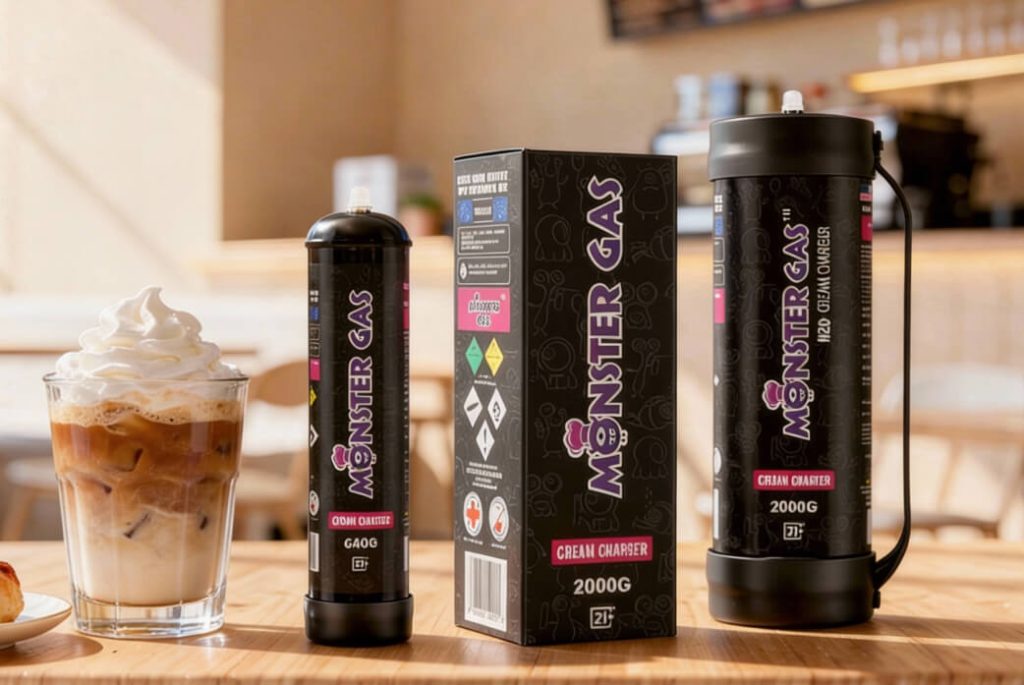
MonsterWhip supplies food-grade E942 nitrous oxide in three formats suited to different production volumes: 8g single-use chargers (cases of 24, 50, or 100), 640g professional tanks (cases of 6), and 2kg commercial cylinders for high-volume pastry and bar operations. All formats ship with E942 certification documentation and lot-traceable CoAs available on request. Wholesale accounts receive volume pricing, standing-order schedules, and dedicated account management.
Contact our sales team to request a quote or to receive sample CoA documentation before your first order.
Ready to stock up? See our N2O wholesale pricing, browse the MonsterWhip shop, or request a wholesale quote — we reply within 24 hours.
Frequently Asked Questions About E942 Nitrous Oxide
Is your N2O E942 certified?
Yes. Every batch of our N2O is fully E942 food-grade certified, meeting EU and US food-safety standards for use in whipped cream chargers and other culinary applications. A Certificate of Analysis (CoA) is available for every batch on request.
Is E942 nitrous oxide legal in the US?
Yes, E942 food-grade nitrous oxide is legal for culinary use across the US when sold and used as intended for whipping cream. Some states restrict retail sales of standalone canisters or set minimum purchase ages — check your local regulations, and see our wholesale page for state-specific shipping guidance.
What’s the difference between food-grade and industrial N2O?
Food-grade E942 N2O is produced and filtered to a minimum 99.5–99.7% purity with no oil or hydrocarbon residue, making it safe for direct contact with food. Industrial-grade N2O is not certified for food contact and can contain trace contaminants that make it unsafe for consumption — always confirm your supplier’s certification before buying in bulk.
What does E942 stand for?
The "E" marks a food additive authorised for use across the European Union, and 942 is the specific number assigned to nitrous oxide. Numbers in the 900s are propellants, glazing agents and packaging gases, which is why E942 sits where it does. The letter is not a grade or a ranking — every authorised EU food additive has one.
Is E942 safe to eat?
Nitrous oxide used as a food propellant has been assessed by EFSA and is authorised quantum satis, meaning regulators did not consider a numerical intake limit necessary. In practice the gas does not remain in the food: it expands, aerates the cream or foam, and disperses. What makes E942 safe in a kitchen is purity and traceability, which is exactly what the designation is there to guarantee.
Is E942 vegan, halal and kosher?
E942 is nitrous oxide, a gas produced by the controlled thermal decomposition of ammonium nitrate. No animal-derived material is involved at any stage, so it is suitable for vegan, halal and kosher preparation. If you are certifying a product rather than just serving it, ask your supplier for the relevant certificate — the certification applies to the production facility, not to the molecule.
What is INS 942?
INS 942 is the same additive as E942, listed under the Codex Alimentarius International Numbering System rather than the European scheme. If you are sourcing for a market outside Europe, INS 942 is the designation you will see on technical data sheets, and it means precisely the same thing.
Is E942 the same as laughing gas?
Chemically, yes — both are nitrous oxide. Commercially and legally they are not interchangeable. E942 refers specifically to nitrous oxide manufactured, tested and documented to food additive standard for culinary use. The recreational misuse that attracts the "laughing gas" label involves the same molecule obtained outside that chain of control, and it is what has driven the tighter European restrictions described above.
Do I need E942 documentation for a food safety audit?
If you aerate anything you serve, yes. An inspector working through a HACCP plan will expect to see that the gas touching your food is an approved additive, which means a Certificate of Analysis, a lot number that matches the delivery, and packaging that states E942. "Food grade" written on a box is not evidence. The E number and the paperwork behind it are.
Recent posts
- How to Spot Fake or Low-Quality Cream Chargers: A Wholesale Buyer’s Checklist
- 640g vs 2kg Cream Chargers: Which Size Is Right for You?
- Cream Chargers Chicago: Wholesale N2O for Restaurants, Bars & Catering
- Cream Chargers Miami: Wholesale N2O for Restaurants, Bars & Catering
- Cream Chargers Houston: Wholesale N2O for Restaurants, Bars & Catering