Share:
Cream Charger Sizes Explained: 8g vs 16g vs 640g (2026 Buying Guide)
Choosing between cream charger sizes is the single most common question we get from new customers. Should you buy classic 8g capsules, step up to 16g, or move to a 640g (and larger) N2O cylinder? The right answer depends on how much whipped cream you make, how often you make it, and whether you are buying for home, a busy café, or wholesale resale. This guide breaks down every size, the real cost per litre, and exactly which option gives you the best value in 2026.
What a cream charger actually does
A cream charger is a small steel cartridge filled with food-grade nitrous oxide (N2O, additive code E942). When you screw it into a whipping siphon, the gas dissolves into the cream under pressure. As you press the lever, the cream expands into stable, airy foam. The gas does two jobs at once: it aerates the cream and it stabilises the foam so it holds its shape far longer than cream beaten by hand or machine. Because the N2O is food grade and certified E942, it is the correct gas for any culinary use — never substitute CO2, which turns cream sour and flat.
The amount of gas inside the charger is what the “size” refers to. More gas means more cream per charge and, almost always, a lower cost per litre. That is the core trade-off behind every buying decision below.
8g cream chargers: the classic standard
The 8g charger is the original and most widely recognised size. One 8g cartridge charges roughly half a litre (0.5 L) of liquid cream, which expands to around 1.5 litres of whipped volume. They fit virtually every standard half-litre and one-litre whipping siphon on the market, which is why they remain the default choice for home cooks and small kitchens.
Choose 8g chargers if you make whipped cream occasionally, own a standard consumer siphon, or want maximum compatibility. The downside is cost: bought in small boxes, the price per litre of finished cream is the highest of any format. If you are charging more than a few siphons a week, you are leaving money on the table.
16g cream chargers: more gas, fewer reloads
16g chargers hold double the nitrous oxide of an 8g cartridge. In practice that means fewer cartridge changes during a busy service and a noticeably lower cost per litre. Many professional-grade siphons are built specifically for 16g cartridges, and a growing number of cafés have switched to them purely to cut down on the number of capsules staff have to load and dispose of mid-shift.
Choose 16g if you run a café, dessert bar, or cocktail bar with steady but not industrial volume, and your siphon is rated for them. Always check your siphon’s specification first — loading a 16g charger into a siphon designed only for 8g can damage the valve.
640g, 640g and larger N2O cylinders: built for volume
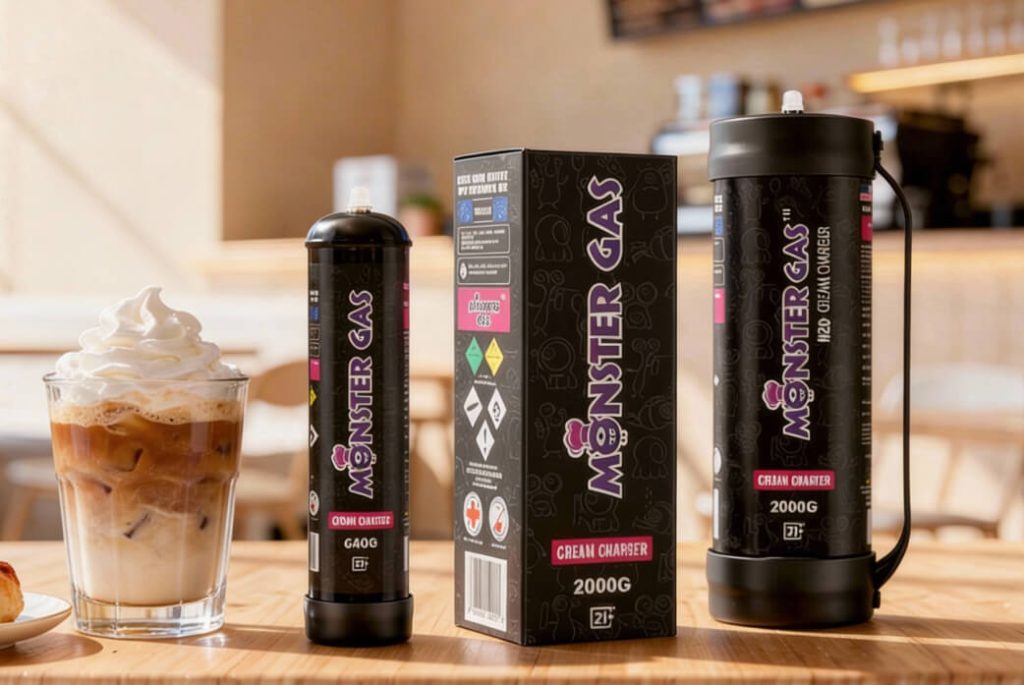
Once your output climbs, single-use cartridges stop making sense. A 640g cylinder holds the equivalent of roughly seventy 8g chargers; our popular 640g, 2kg and 3.3kg cylinders go far beyond that. These connect to your siphon via a regulator or charging hose, so instead of loading dozens of small capsules you simply re-pressurise from one tank. The cost per litre drops dramatically, and you generate far less steel waste.
Choose a large cylinder if you are a high-volume café, restaurant, catering company, or a wholesaler reselling to trade customers. The upfront price is higher, but the per-litre economics are unbeatable, and refilling is faster than swapping capsules during peak service. Every MonsterWhip cylinder is filled with E942 food-grade N2O and dispatched across the EU.
Cost per litre: the comparison that actually matters
Headline price per box can be misleading. What matters is how much it costs to produce one litre of finished whipped cream. As a rule of thumb, 8g cartridges are the most expensive per litre, 16g cartridges cut that meaningfully, and 640g+ cylinders are the cheapest by a wide margin once you account for the gas volume. If you are making cream daily, moving up one size tier typically pays for itself within weeks.
The second hidden cost is labour and waste. Loading and disposing of forty 8g capsules takes time and creates a pile of steel to recycle. One cylinder charge does the same work with a fraction of the handling. For any commercial kitchen, that operational saving often outweighs the gas price itself.
Which size should you buy?
For home use and occasional desserts, stick with 8g chargers and a standard siphon — simple, compatible, and no special equipment needed. For a café or bar with regular orders, move to 16g chargers if your siphon supports them, or step straight to a 640g/640g cylinder if you are charging multiple siphons a day. For restaurants, caterers, and resellers, a 2kg or 3.3kg cylinder delivers the lowest cost per litre and the least downtime during service.
If you are still unsure, the deciding question is simple: how many litres of cream do you make per week? Under two litres, stay with capsules. Two to ten litres, consider 16g or a small cylinder. Over ten litres, a large cylinder will save you money every single week.
Compatibility: will the charger fit your siphon?
Size is not just about gas volume — it is also about fit. Standard 8g threaded chargers are universal and fit almost every consumer and professional siphon ever made, which is part of why they remain so popular. 16g chargers, however, are slightly longer and only work with siphons specifically rated for them; forcing a 16g cartridge into an 8g-only holder can crack the valve or cause leaks. Large cylinders (640g and up) never screw directly onto a siphon: they connect through a pressure regulator and a charging hose, so you also need the correct regulator for that cylinder’s valve thread. If you are upgrading sizes, always confirm your siphon’s rating first, or ask our team to match the right cylinder, regulator, and hose as a set.
Environmental and storage considerations
Single-use 8g and 16g cartridges are made of recyclable steel, but high volume means a lot of empty capsules to collect and recycle. Larger cylinders dramatically reduce that waste because one tank replaces dozens of small cartridges. Whichever size you choose, store them in a cool, dry place away from direct sunlight and never above 50°C — heat raises internal pressure. Keep them upright and away from open flames. Stored correctly, the gas quality stays perfect for a long time, so buying in bulk does not mean compromising freshness.
Frequently asked questions
How much whipped cream does one 8g charger make? Roughly half a litre of liquid cream, which expands to around 1.5 litres of whipped volume. Can I use a 16g charger in an 8g siphon? Only if the siphon is rated for 16g — check the manufacturer’s specification first. Is a 640g cylinder worth it for a small café? If you charge more than a couple of siphons a day, yes: the per-litre saving and reduced reloads pay back quickly. Do bigger sizes use a different gas? No — every size uses the same 99.9% pure, E942 food-grade N2O; only the quantity changes.
Quality and safety: always check the gas grade
Whatever size you choose, the gas inside must be food grade. Look for 99.9% pure N2O certified as E942 — this is the only grade safe and legal for culinary use. Cheap, uncertified cartridges can carry impurities that leave a metallic aftertaste and are not intended for food. Every MonsterWhip charger and cylinder is filled with certified E942 food-grade nitrous oxide, so you get clean taste and stable foam every time.
Ready to order?
Whether you need a few boxes of 8g chargers or a pallet of 3.3kg cylinders for wholesale, MonsterWhip ships fast across the EU. Place your order through the form on this page, or message us directly on WhatsApp for same-day quotes and bulk pricing. Order before 14:00 for fast dispatch, and our team will help you match the right size to your exact volume.
Related guides & wholesale info
- Wholesale N2O cream charger pricing — pallets and container rates (MOQ: 1 pallet).
- N2O cost calculator — compare cost per litre across sizes.
- Request a wholesale quote for your business.
Recent posts
- How to Spot Fake or Low-Quality Cream Chargers: A Wholesale Buyer’s Checklist
- 640g vs 2kg Cream Chargers: Which Size Is Right for You?
- Cream Chargers Chicago: Wholesale N2O for Restaurants, Bars & Catering
- Cream Chargers Miami: Wholesale N2O for Restaurants, Bars & Catering
- Cream Chargers Houston: Wholesale N2O for Restaurants, Bars & Catering