Share:
Cream Chargers for Catering & Events Guide
Cream Chargers for Catering and Events: A Wholesale Sourcing Guide
Catering is different from restaurant service. You’re not standing in your own kitchen with established storage and supply chains. You’re traveling to venues, working in temporary kitchens, managing variable guest counts, and often operating under time constraints.
Cream chargers are invaluable for catering—they enable sophisticated garnishes, quick infusions, and memorable presentations. But sourcing, transporting, and using N2O in event settings presents unique challenges.
This guide walks through how to source cream chargers for catering operations, manage supply across different event types, and optimize costs without sacrificing reliability.
Types of Events and N2O Usage Patterns
Different events have different N2O requirements. Understanding this helps you plan supply.
Wedding Receptions (50–300 guests)
Typical uses: Whipped cream on desserts, foam garnishes for plated courses, nitro-infused cocktails, edible flowers in aerated cream.
Timeline: 4–6 hour service window, usually one or two service points.
Charger usage: 30–100 chargers for the event, depending on guest count and sophistication of menu.
Supply strategy: Arrive with enough chargers to cover the entire event plus 20% backup. For a wedding with 150 guests, plan for 80–100 chargers.
Corporate Events and Galas (100–500+ guests)
Typical uses: Multiple stations (cocktail hour foam garnishes, dinner course foams, dessert presentations), interactive elements (live foam demonstrations), passed hors d’oeuvres with nitrogen-prepared components.
Timeline: 6–8 hour events, multiple service stations.
Charger usage: 150–400+ chargers depending on menu complexity and guest count.
Supply strategy: Stock at multiple stations. Plan for restocking between service phases. Bring 30–40% more chargers than expected usage to account for experimentation and backup.
Pop-Up Restaurants and Festivals (50–500+ covers over 1–3 days)
Typical uses: Consistent menu with foam and infusion elements, served repeatedly over multiple seatings.
Timeline: Multiple service periods daily, potentially multi-day events.
Charger usage: Varies widely. A 3-day festival serving 100 guests per day might use 600–1,000 chargers total.
Supply strategy: Calculate per-cover charger usage, then order 1.5x the expected amount. For multi-day events, have delivery capability or backup supplies staged locally.
Product Launches, Trade Shows, and Promotional Events (food tastings, 100–1,000 guests)
Typical uses: Signature foam element that becomes synonymous with the event, infused beverages, aerated garnishes.
Timeline: Single day, often 4–6 hours.
Charger usage: Depends heavily on event focus. If N2O is the centerpiece, usage can be high. Plan 2–4 chargers per guest for events where foam is the main draw.
Supply strategy: Overstock generously. Running out of a signature element is worse than overbuying. Plan for 50% more than your conservative estimate.
Quantity Planning: Calculating Charger Needs by Event Type
How many chargers do you actually need? Here’s a framework.
Starting with Per-Cover Estimates
Different event types have different charger density:
- Fine dining (seated plated service): 0.5–1 charger per cover (multiple small foam elements across the meal)
- Catered cocktail + dinner (passed appetizers + plated course): 1–2 chargers per cover
- Cocktail reception (foam-heavy): 2–3 chargers per cover (multiple foam-garnished drinks)
- Festival/pop-up (repeated menu, multiple seatings): 0.3–0.5 chargers per cover (more efficient with experience)
- Wedding (elegant but measured use): 0.4–0.6 chargers per cover
Practical Examples
Example 1: 100-guest wedding dinner
- Per-cover estimate: 0.5 chargers/cover
- Base need: 50 chargers
- Add buffer (30%): 15 chargers
- Total to stock: 65 chargers
Example 2: 200-guest corporate gala with cocktail hour (foam-heavy)
- Cocktail hour (100 guests, heavy foam use): 150 chargers
- Dinner service (200 guests, moderate foam): 100 chargers
- Subtotal: 250 chargers
- Add buffer for restocking/backup: 50 chargers
- Total to stock: 300 chargers
Example 3: 3-day pop-up restaurant (100 covers/day, simple menu with one foam element)
- Daily usage: 100 covers × 0.4 chargers = 40 chargers
- 3 days: 120 chargers
- Add buffer: 30 chargers
- Total to stock: 150 chargers
Portable vs Fixed Setups: Infrastructure Considerations
How you set up N2O capability at an event depends on the venue and your operation.
Portable Foam Dispensers (Most Events)
Setup: Self-contained foam dispensers filled before service, then taken to plating stations or passed by servers.
Charger consumption: One full dispenser = one 8g charger (or larger chargers for bigger dispensers). Refill dispensers between service phases.
Advantages:
- No infrastructure needed
- Works at any venue
- Easy to manage multiple stations
- Flexible charger usage (fill only what you need)
Disadvantages:
- Labor-intensive (someone manages refilling)
- Requires discipline (track which dispensers are running low)
- More chargers needed overall (some waste when changing flavors)
Best for: Most catered events. It’s the standard in the industry.
Wheeled Foam Station Setup
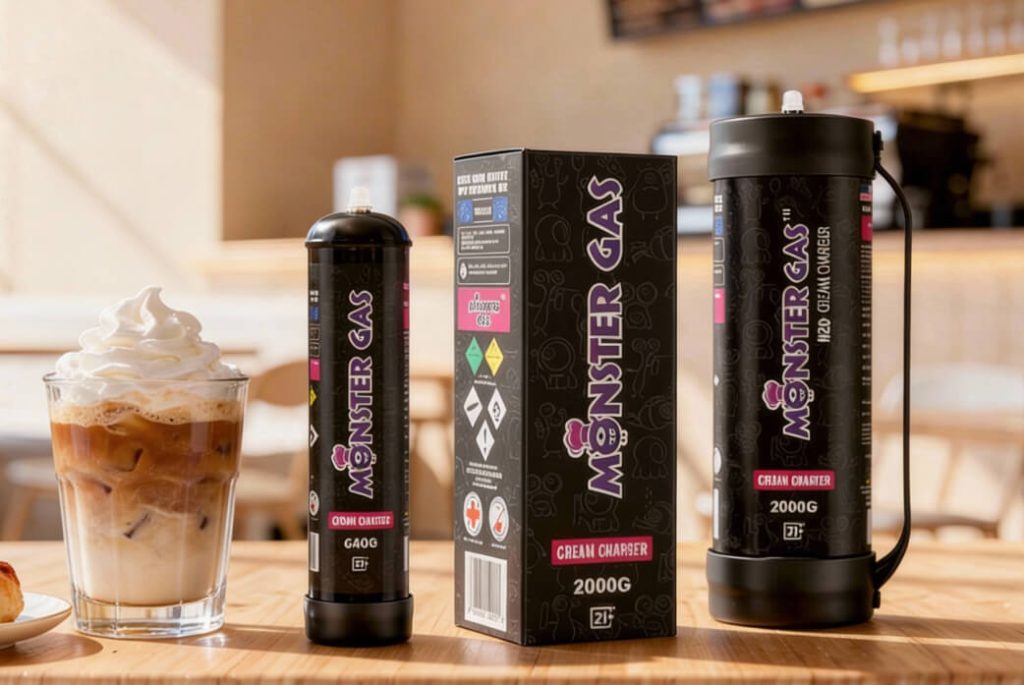
Setup: A mobile cart or station with a larger N2O cylinder (640g or 2kg) and multiple dispensers connected to a manifold system.
Charger consumption: One 640g or 2kg cylinder replaces 80–250 individual chargers, respectively.
Advantages:
- Professional appearance (guests can see the setup)
- Efficient gas consumption (no waste)
- Multiple flavor options available simultaneously
- Lower per-serving cost (for high-volume events)
Disadvantages:
- Requires specialized equipment (regulators, tubing, manifolds)
- Setup/breakdown time (30–60 minutes)
- Not all venues allow it (health regulations, space constraints)
- Requires trained staff to operate safely
Best for: Large events (200+ guests), multi-day festivals, product launches where N2O is a centerpiece.
Hybrid Approach
Many catering companies use both: portable dispensers for most service, and a wheeled station for peak service times or as a guest-facing interactive element.
Just-In-Time Ordering: Managing Charger Supply Across Multiple Events
Catering companies handle multiple events weekly, often across different regions. Sourcing cream chargers requires flexibility.
Challenge 1: Unpredictable Demand
You don’t know the final guest count until days before the event. You can’t order chargers until you know what you need. This creates timing pressure.
Solution: Partner with a supplier like MonsterWhip that offers:
- Next-day or same-day delivery (for last-minute events)
- Flexibility on order size (you can order 100 chargers without minimum lot requirements)
- Easy communication (reliable contact for urgent restocking)
Challenge 2: Storage Between Events
You might not have permanent kitchen space. Where do you store chargers between events?
Solutions:
- Rented by the event: Order chargers specifically for each event, return unopened boxes to the supplier (some allow this).
- Mobile storage: Keep chargers in a climate-controlled van or portable unit.
- Partner storage: Rent small fridge/storage space from a local commercial kitchen or food incubator.
- Just-in-time ordering: Order chargers a few days before each event, keep minimal buffer stock.
Challenge 3: Geographic Distribution
Your events are across a region. Shipping to your central location, then driving chargers to each event, is inefficient.
Solutions:
- Regional suppliers: Partner with suppliers like MonsterWhip that have distribution in your region. Order locally for each event.
- Negotiated rates: As a consistent customer, negotiate standing delivery discounts.
- Consolidated ordering: Order for multiple events in a region in one shipment, then distribute locally.
Temperature and Outdoor Considerations
Events happen everywhere—outside in parks, under tents, in uncontrolled venues. How do you manage cream chargers in these conditions?
Outdoor Summer Events
Challenge: Heat. Cream chargers in direct sunlight or warm tents can reach dangerous temperatures, increasing internal pressure.
Solutions:
- Store chargers in insulated boxes or coolers with ice packs (not water, which causes corrosion)
- Keep chargers in the shade at all times
- Refill dispensers indoors or in a cool tent immediately before use
- Don’t leave filled dispensers in the sun; keep them on ice
- For multi-hour outdoor events, have a shaded dispensing station with chargers nearby on ice
Cold Weather Events
Challenge: Cold reduces gas pressure and efficiency. Dispensers don’t work optimally below 10°C.
Solutions:
- Keep chargers and dispensers indoors until immediately before use
- Prepare filled dispensers in a warm kitchen, transport in insulated boxes, use quickly
- If using a wheeled station outdoors, position it in the warmest available location
- For very cold events, increase charger count (expect lower efficiency)
Humidity and Moisture
Challenge: Tents and outdoor venues can be humid. Moisture causes external corrosion.
Solutions:
- Store chargers in dry boxes, not directly on wet ground
- Use pallets or raised platforms
- Inspect chargers for corrosion before using (especially critical for reusable larger cylinders)
Cost Optimization: Wholesale Sourcing for Catering Operations
As a catering company, your charger costs scale quickly. Moving from retail to wholesale sourcing is essential.
Retail vs Wholesale for Caterers
Retail pricing: Local supplier, €1.50–2.00 per charger. For a catering company doing 5–10 events weekly (500–1,000 chargers/month), annual cost: €9,000–24,000.
Wholesale pricing: MonsterWhip at €0.30–0.40 per charger. Same volume: €1,800–4,800 annually.
Annual savings: €7,200–20,000
That’s not marginal—that’s 70–80% cost reduction.
Negotiating Terms for Catering Companies
As a consistent, predictable customer, you have leverage. When talking to MonsterWhip, mention:
- Your monthly volume (be honest and specific)
- Your service area (they may have local distribution)
- Your need for flexibility (varying order sizes, quick delivery)
- Your interest in longer-term partnership (multiple events/months)
Negotiate:
- Volume-based pricing (deeper discounts at higher volumes)
- Delivery terms (frequency, timing, potential local pickup)
- Account flexibility (ability to adjust orders based on event changes)
- Payment terms (net 30 for established accounts)
Equipment and Infrastructure Investment
If you’re expanding N2O use in your catering, consider equipment investments that improve efficiency.
Foam Dispensers
High-quality dispensers last years. Budget €150–300 for professional-grade options. Having 3–4 dispensers lets you prep multiple flavors simultaneously and provides backup if one fails.
Wheeled Station Setup
If multi-day or high-volume events are part of your growth, a mobile foam station (€1,000–3,000) pays for itself through charger cost savings and professional presentation. You’ll use 640g or 2kg cylinders instead of hundreds of 8g chargers, reducing cost per serving significantly.
Transport and Storage
Climate-controlled storage or an insulated transport box (€200–1,000) protects chargers and ensures reliability. For a catering company, this is foundational—charger failure during an event is reputation damage.
Practical Sourcing Workflow for Catering Companies
Here’s a system that works:
- Plan your calendar: At the start of each month, review upcoming events and estimate total charger needs.
- Bulk order baseline supply: Order a month’s worth at volume pricing from MonsterWhip. Store in a climate-controlled location or van.
- Event-specific top-ups: 3–4 days before each event, order any additional chargers specific to that event (based on final guest count confirmation).
- Just-in-time infusions: If you’ll be infusing unique spirits or syrups for an event, order chargers 1–2 days before (allows prep time).
- Track usage: Log charger usage by event. This data improves future planning and justifies bulk ordering.
- Maintain buffer stock: Keep 200–500 chargers on hand for emergency restocking or unexpected events.
Real-World Example: Scaling a Catering Operation
Scenario: A 15-person catering company doing 2 events weekly (24 events/month). Initial events averaged 80 guests; they now average 120. N2O use is becoming more prominent in their menu.
Old model: Buying retail (€1.75/charger), ordering reactively, storage scattered across different kitchens.
- 24 events × 80–120 chargers/event = 2,000–3,000 chargers/month
- At €1.75: €3,500–5,250/month = €42,000–63,000/year
New model: Wholesale with MonsterWhip (€0.32/charger), systematic ordering, centralized storage.
- Same volume (2,000–3,000 chargers/month)
- At €0.32: €640–960/month = €7,680–11,520/year
- Annual savings: €30,480–55,320
Plus, they invested €800 in an insulated transport box and a small (€1,500) wheeled foam station for signature events. These investments paid for themselves in 1–2 months through charger cost savings and improved event execution.
Next Steps: Scaling Your Catering N2O Supply
If you’re running a catering company and want to optimize charger sourcing:
- Audit current usage. Track charger consumption across your last 10–20 events. Calculate average per-cover usage.
- Calculate current spend. Units × retail price.
- Get a wholesale quote. Contact MonsterWhip with your consumption data. They’ll tailor pricing and terms to your operation.
- Establish a supply system. Coordinate with MonsterWhip on ordering frequency, storage, and delivery timing.
- Invest in infrastructure. Budget for quality dispensers and appropriate storage/transport.
For detailed guidance on sourcing at scale, see our comprehensive wholesale sourcing guide. And for best practices on handling and storing chargers across multiple locations, check our storage and safety guide.
Ready to optimize your catering company’s N2O supply? Reach out to MonsterWhip to discuss your event catering needs and negotiate wholesale pricing tailored to your operation.
Related MonsterWhip Resources
Wholesale Europe · Wholesale USA · N2O Laws by Country · Cost Calculator · Compare Brands
Looking for wholesale N₂O cream chargers?
MonsterWhip supplies food-grade N₂O to restaurants, bars and caterers across Europe. Fast delivery, EU-certified, 99.7% purity.
- MonsterWhip 2KG N₂O Cylinder — from €21 per cylinder
- ★ Pallet of 168 × 2KG — best wholesale price, €3,528 + shipping
- Browse the full product range →
- Request a wholesale quote →