Share:

Best Cream Chargers for Restaurants: A Wholesale
Choosing the right cream charger supplier can make or break the dessert programme at a busy restaurant. Between inconsistent quality, unreliable deliveries, and spiralling costs from single-use 8g capsules, many chefs and restaurant owners find themselves spending more time managing their whipped cream supply chain than perfecting their menus.
This guide breaks down exactly what to look for when buying cream chargers at wholesale volume, compares the most common formats on the market, and explains why an increasing number of professional kitchens are switching to large-format N2O tanks.
What Makes a Cream Charger “Restaurant-Grade”?
Not every cream charger on the market is suitable for a commercial kitchen. Restaurant-grade cream chargers must meet three non-negotiable criteria. First, the N2O inside must be certified food-grade with a purity of 99.7% or higher. This ensures clean flavour with no metallic or chemical aftertaste. Second, the charger or tank must be manufactured under strict quality control with consistent fill weights — nothing disrupts kitchen workflow like a batch of underfilled chargers that produce flat, watery cream. Third, the packaging and valve system must be reliable and leak-free, especially for high-volume tanks that will see daily use.
MonsterWhip products are engineered specifically for the hospitality industry. Every cylinder is pressure-tested, filled to specification, and backed by food-grade certification that you can share with health inspectors and regulatory auditors.
8g Chargers vs. 640g Tanks vs. 2kg Tanks: Which Is Right for Your Kitchen?
8g Cream Chargers
The traditional single-use capsule remains popular for low-volume use. Each 8g charger produces roughly 0.5 litres of whipped cream. For a restaurant that serves 20–30 desserts per evening, you would burn through 10–15 chargers daily. The per-litre cost is the highest of all formats, and the waste generated — dozens of small steel capsules per day — adds up quickly. Best suited for small bistros, pop-ups, or as a backup supply.
640g Cream Charger Tanks
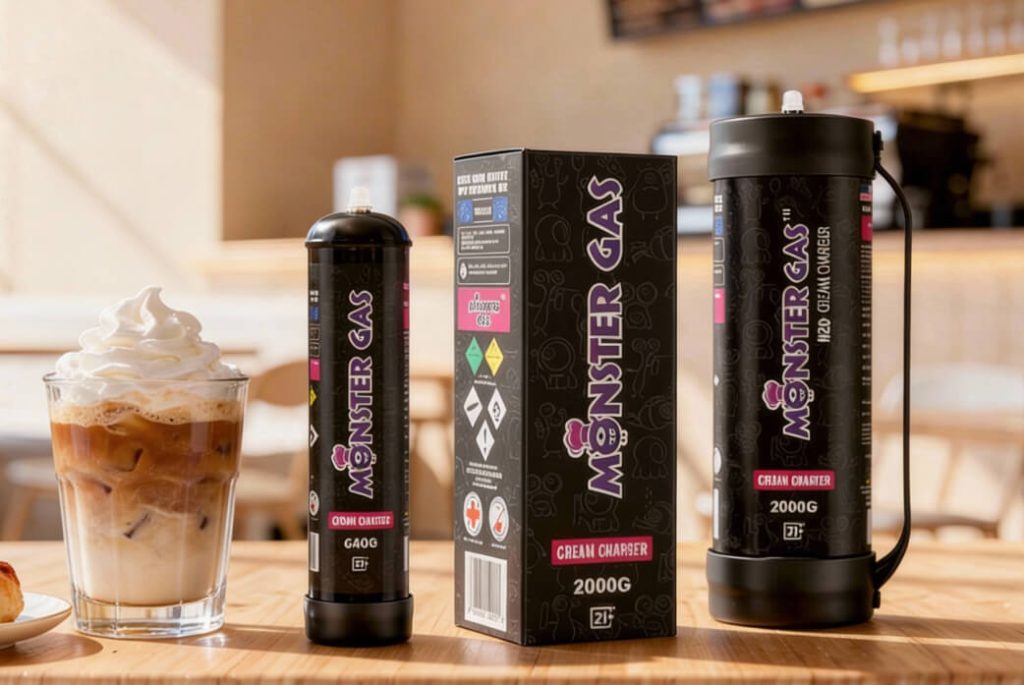
Mid-range tanks like the MonsterWhip 640g cylinder are the sweet spot for most restaurants. One 640g tank replaces approximately 80 individual 8g chargers, which means fewer changeovers during service, less waste, and a significantly lower per-litre cost. The compact size fits easily into standard kitchen storage, and the threaded nozzle connects directly to professional cream dispensers. For restaurants serving 50–100 desserts per day, two to three 640g tanks per week is typically sufficient.
2kg N2O Tanks
For high-volume operations — hotel restaurants, catering companies, large bakeries, and dessert bars — the MonsterWhip 2KG tank is the most cost-effective option on the market. A single 2kg cylinder replaces roughly 250 individual 8g chargers. The pressure-regulated valve ensures consistent output from first dispense to last, and the per-litre cost is a fraction of what you would pay with smaller formats. Many of our restaurant clients report savings of 40–60% after switching from 8g chargers to 2kg tanks.
Cost Comparison: The Real Numbers
Let us put concrete numbers on the table. A restaurant producing 50 litres of whipped cream per week would need approximately 100 individual 8g chargers at typical wholesale pricing. Switching to 640g tanks cuts that to roughly 4 tanks per week, while a 2kg setup requires just over one tank per week. The savings compound rapidly — many of our wholesale clients recover their first order investment within the first month of switching formats.
Beyond the direct cost savings, large-format tanks reduce the hidden costs of kitchen operations: less time spent on charger changeovers during busy service, less packaging waste to manage, fewer supplier orders to process, and more consistent cream quality across every plate that leaves the pass.
Storage, Safety, and Compliance in Commercial Kitchens
Proper storage of N2O cylinders in a restaurant environment is straightforward but important. Tanks should be stored upright in a cool, dry area away from direct heat sources and open flames. Most commercial kitchen environments are perfectly suitable. All MonsterWhip cylinders are designed with safety pressure-release mechanisms that prevent over-pressurisation, and each unit is individually tested before leaving our facility.
From a compliance perspective, food-grade N2O (classified as food additive E942 in the EU) is approved for use in food preparation across all major markets. MonsterWhip provides full certification documentation including certificates of analysis and material safety data sheets, making it easy to demonstrate compliance during health and safety inspections.
Why Restaurants Are Choosing MonsterWhip
The cream charger market is crowded, but professional kitchens need a supplier they can rely on every single day. Here is what sets MonsterWhip apart for restaurant buyers:
- Consistent quality — Every cylinder contains certified food-grade N2O at 99.7%+ purity, with no variation between batches
- Full product range — From 8g chargers for backup use to 2kg tanks for high-volume production, all from a single supplier
- Fast wholesale delivery — Stock arrives when you need it, not when it suits the logistics company
- Transparent pricing — Volume-based wholesale pricing with no hidden fees, surcharges, or minimum order tricks
- Real support — Questions answered quickly by people who understand the hospitality industry
Whether you run a single restaurant or manage purchasing for a multi-site hospitality group, MonsterWhip has the products, pricing, and logistics to keep your kitchen running smoothly.
Get Started with Wholesale Pricing
Switching to a better cream charger supplier takes five minutes. Send us a message on WhatsApp with your approximate weekly volume, and we will have a custom wholesale quote back to you within 24 hours. Or visit our distributor page to explore partnership options for larger operations.
Related Articles
- 5 Professional Whipped Cream Recipes Every Cafe Should Know
- The Science of N2O: Why Food-Grade Nitrous Oxide Matters
- MonsterWhip vs ExoticWhip: Wholesale Comparison
- 640g vs 2kg Cream Chargers: Which Size Is Right?
- N2O Cream Chargers for Restaurants and Bars: Wholesale Savings
Related MonsterWhip Resources
Wholesale Cream Chargers Europe · Wholesale USA · N2O Laws by Country · Cost Calculator · Compare Brands
Ready to stock up? See our N2O wholesale pricing, browse the MonsterWhip shop, or request a wholesale quote — we reply within 24 hours.